
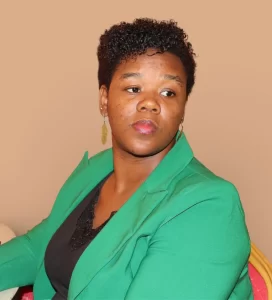
 Dr. Stéphanie Dominique Amida Nama is the Co-Founder of KAIROS – Kaléidoscope d’Actions Intégrées pour la Recherche et l’Optimisation en Santé, an innovation-driven healthtech and preventive-health education startup based in Burkina Faso. She is a medical doctor, public health specialist, independent consultant, partner, and mother of two children – identities she carries as interconnected sources of strength, responsibility, and purpose.
What inspired you to work in health in Africa?
Since childhood, I knew I wanted to be a family doctor, caring for communities as a whole, choosing medicine felt natural. My journey in health in Africa deepened through clinical and public health research on obstetric fistula in Burkina Faso, a condition often described as a “disease of shame” due to stigma and exclusion. Listening to survivors’ stories showed me that health is not only about treatment, but also dignity, access, and social cohesion. Confronted with these realities, I co-founded KAIROS, a healthtech and preventive-health education startup creating context-driven solutions to empower communities and strengthen health systems
What is one success you’re proud of?
One success I am particularly proud of is that KAIROS was selected as one of only seven startups worldwide, out of more than 900 applicants, to join the UNICEF Venture Fund 2025-2026 cohort. We have partnered with the European firm ImpactScope to develop WobSongo, an AI-powered solution to protect young people from health-related misinformation and strengthen digital trust. I am also proud of having previously mobilized and trained young people across Burkina Faso to form the first cohort of Eco-Ambassadors, who reached over 5,000 peers on Sexual and reproductive health and rights (SRHR) and Gender-based violence (GBV) in just nine months. These experiences reflect my commitment to bridging innovation and community-driven impact.
What’s the hardest part of your work as a woman in health leadership? How are you tackling it?
One of the hardest parts is navigating complex systems that were not designed to fully recognize or support women’s leadership, especially in fragile contexts. As an independent consultant, I often operate at the intersection of policies, donor procedures, and urgent community needs. I address this by building strong alliances, particularly through women-led networks, and by developing practical tools that connect sectors and actors. I also believe deeply in mentorship and collective leadership as ways to shift power dynamics.
What change do you want to see in the next 5 years?
In the next five years, I want to see health systems in Africa move decisively from disease-centred models to prevention and well-being-oriented approaches. I hope to see women and young people recognized not just as beneficiaries, but as co-designers and leaders of solutions. Stronger integration across sectors as health, climate, education, and social protection is very essential. Above all, I want equity and dignity to become non-negotiable pillars of health action.
What advice do you have for women chasing their dreams working in health?
Believe in the value of your voice, even when systems try to silence or minimize it. Seek out women-led networks and mentors, many of my own opportunities became possible through these connections. Do not wait for perfect conditions to act; start where you are and learn along the way. And remember that your lived experience is not a weakness, but a powerful source of leadership.