
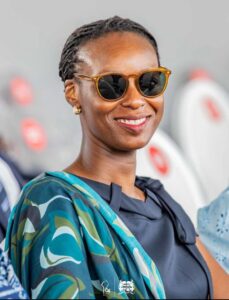
 What inspired you to work in health in Africa?
My parents are from Benin, which is in Africa. So my home was always Africa, even while growing up in the Maryland suburbs, my childhood was stewarded by two proud and brilliant Africans. At age 11 my family moved back to Benin, where I graduated high school. During those years, having always been called to a life in healthcare, I was particularly struck by a personal situation where patient outcomes were entirely based on social determinants of health. I was the youngest of the three patients, the most privileged and I had the best outcome (thus far). It seemed terribly unfair and the gap seemed incomprehensible. So right then and there I committed to working to close that gap using all my privilege. 25 years later, here I am.
After nearly 10 years as a full time US-based clinical Ob/Gyn health provider and medical educator I switched to being a full time county-based public health coordinator during COVID times in the Baltimore, MD area (USA). Less than a year later, I took another leap and took a national public health advisor position in Benin in 2022. It’s been nearly 4 years, and what an experience it has been…
What is one success you’re proud of?
As I look at healthcare, I see people and systems.
For the people, I put a lot of stock in early childhood education, early brain stimulation and youth development. For the systems, I put a lot of faith in good tools, the best of which are currently technological. The future is in each little kid’s imagination.
One budding success that I am truly proud of is a character I have created. After many stakeholder meetings, multiple reworded reports, several awesome conferences, I realized that there was a missing link: the youngest ones of us are often missing from the circle. So I wonder how are we planning our succession? I am doing it through a comic book that I am slowly creating. It is destined to stimulate the minds of our 7-12 year olds, point them in the path that I hope we are on and encourage them to adopt technology early, with ease and purpose. This character is one that they should all be able to connect and identify with. I think of her as my 8 year old self in my current mission. So stay tuned andfeel free to share any tips on how to mass produce an educational kids book.
What’s the hardest part of your work as a woman in health leadership? How are you tackling it?
I am a working mom of 3. So I have the same challenges any working mother and wife would have. Multitasking to the limit. I am a clinician converted to a public health advisor. I have traded the instant gratification of a successful c-section for the number of recommendations a report on maternal mortality contains, assuming some of them will be executed. These are the challenges of any clinician working in public health. More specifically, as a woman in a health leadership role, two aspects have proven quite challenging for me: my packaging and my delivery. In my days as a full time obstetrician/gynecologist, I usually wore a white coat, scrubs or a relatively simple professional attire. What mattered most was how I treated patients, how I made them feel and how I helped them reach an optimal level of health that was desirable to them. At my current level of leadership, the way that I make people feel depends a lot more on my packaging: my fashion sense are way more scrutinized than that of my male counterparts then ever. I don’t like suits, which my male counterparts wear daily. After resisting this reality, I have turned it into a fun challenge. In addition to my evolving sense of fashion, the way I communicate at this level of leadership has been challenged and required significant growth: I have to make sure I am not being too direct, nor too meek, regardless of the validity of the thoughts and ideas I share. As a clinician, I had a limited time with each patient, the packaging and delivery mattered, but the content: correct diagnosis, recommended treatment, risks, benefits and alternatives, was much more important.
What change do you want to see in the next 5 years?
Naturally I would like to see improved health outcomes for women and babies. An increase in the use of technology (patient vitals’ monitors with IoT capability, telehealth with or without AI) that can effectively lead to reduction in maternal and neonatal mortality through improved responses to abnormal findings.
Improved patient transport adapted to our environment, like the Joby air-taxi or adapted motorcycle taxis.
As a health leader, I would hope for more inclusive spaces for working mothers and their children.
We must recognize how to promote well-being from the youngest age. This could look like accessible childcare at global health conferences for instance. In a more impactful way, this could also look like an increase in playgrounds for young children, better options for street connected youth to enter an adapted workforce.
What advice do you have for women chasing their dreams working in health?
I would recommend that she always continue to believe in herself, follow her purpose and remember to always take good care of herself.